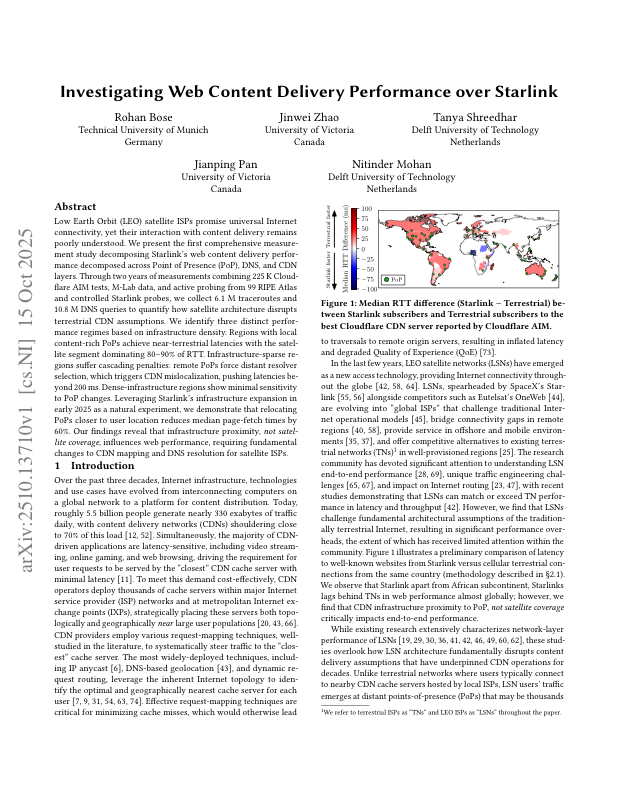
Low Earth Orbit (LEO) satellite ISPs promise universal Internet connectivity, yet their interaction with content delivery remains poorly understood. We present the first comprehensive measurement study decomposing Starlink’s web content delivery performance decomposed across Point of Presence (PoP), DNS, and CDN layers. Through two years of measurements combining 225K Cloudflare AIM tests, M-Lab data, and active probing from 99 RIPE Atlas and controlled Starlink probes, we collect 6.1M traceroutes and 10.8M DNS queries to quantify how satellite architecture disrupts terrestrial CDN assumptions. We identify three distinct performance regimes based on infrastructure density. Regions with local content-rich PoPs achieve near-terrestrial latencies with the satellite segment dominating 80-90% of RTT. Infrastructure-sparse regions suffer cascading penalties: remote PoPs force distant resolver selection, which triggers CDN mis-localization, pushing latencies beyond 200 ms. Dense-infrastructure regions show minimal sensitivity to PoP changes. Leveraging Starlink’s infrastructure expansion in early 2025 as a natural experiment, we demonstrate that relocating PoPs closer to user location reduces median page-fetch times by 60%. Our findings reveal that infrastructure proximity, not satellite coverage, influences web performance, requiring fundamental changes to CDN mapping and DNS resolution for satellite ISPs.
@inproceedings{bose2026starlink,title={Investigating Web Content Delivery Performance over Starlink},author={Bose, Rohan and Zhao, Jinwei and Shreedhar, Tanya and Pan, Jianping and Mohan, Nitinder},booktitle={ACM The Web Conference (WWW)},year={2026},}
BISCAY: Practical Radio KPI Driven Congestion Control for Mobile Networks
Jon Larrea, Tanya Shreedhar, Atte Niemi, Adel Sefiane, and Mahesh K. Marina
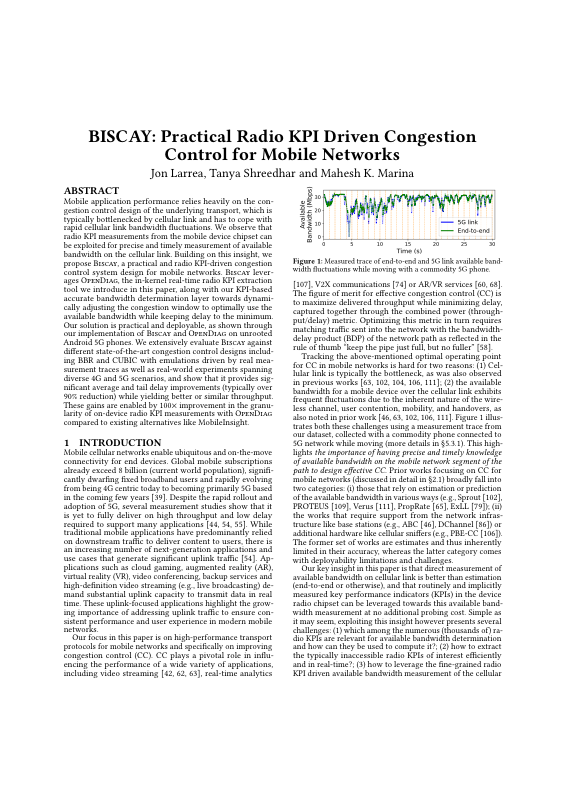
Mobile network performance relies on efficient congestion control that adapts to cellular link characteristics. We propose leveraging radio KPI measurements from the mobile device chipset to measure available bandwidth on cellular links. Our system, Biscay, incorporates OpenDiag—a real-time radio KPI extraction tool—to dynamically adjust transmission parameters. Testing on unrooted Android 5G devices demonstrates over 90% reduction in delay metrics compared to established approaches like BBR and CUBIC, while maintaining comparable throughput across 4G and 5G scenarios.
@inproceedings{larrea2026biscay,title={BISCAY: Practical Radio KPI Driven Congestion Control for Mobile Networks},author={Larrea, Jon and Shreedhar, Tanya and Niemi, Atte and Sefiane, Adel and Marina, Mahesh K.},booktitle={New Ideas in Networked Systems (NINeS)},year={2026},}
2024
Through the lens of Google CrUX: Dissecting web browsing experience across devices and countries
Jayasree Sengupta, Tanya Shreedhar, Dinh Nguyen, Robert Kramer, and Vaibhav Bajpai
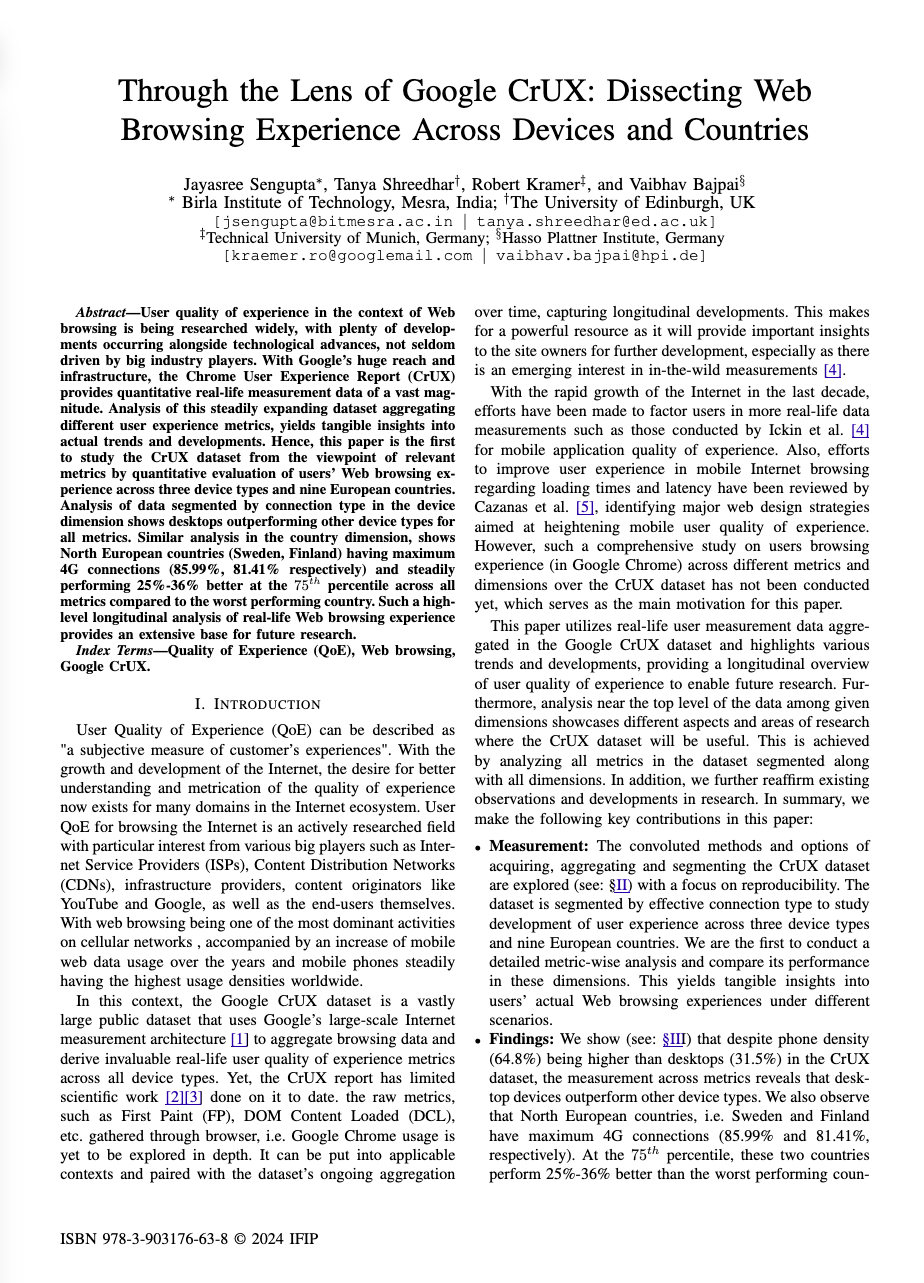
User quality of experience in the context of Web browsing is being researched widely, with plenty of developments occurring alongside technological advances, not seldom driven by big industry players. With the huge reach and infrastructure of Google, the Chrome User Experience Report (CrUX) provides quantitative real-life measurement data of a vast magnitude. Analysis of this steadily expanding dataset aggregating different user experience metrics, yields tangible insights into actual trends and developments. Hence, this paper is the first to study the CrUX dataset from the viewpoint of relevant metrics by quantitative evaluation of users Web browsing experience across three device types and nine European countries. Analysis of data segmented by connection type in the device dimension shows desktops outperforming other device types for all metrics. Similar analysis in the country dimension, shows North European countries (Sweden, Finland) having maximum 4G connections (85.99%, 81.41% respectively) and steadily performing 25%-36% better at the 75th percentile across all metrics compared to the worst performing country. Such a high-level longitudinal analysis of real-life Web browsing experience provides an extensive base for future research.
@article{sengupta2023through,title={Through the lens of Google CrUX: Dissecting web browsing experience across devices and countries},author={Sengupta, Jayasree and Shreedhar, Tanya and Nguyen, Dinh and Kramer, Robert and Bajpai, Vaibhav},journal={IFIP Networking Conference},year={2024},volume={arXiv:2308.06409},number={},pages={1-6},}
We present the age control protocol ACP+, a transport layer protocol that regulates the rate at which update packets carrying information from a source are sent over the Internet to a monitor. The source would like to minimize the average age of information at the monitor. Extensive experimentation helps shed light on age control over the current Internet and its implications for sources sending updates over a shared wireless access to monitors in the cloud. Surprisingly, age minimizing rates over fast Internet paths are about 0.5 Mbps, which is a small fraction, for example, of link rates supported by WiFi wireless access technology. We also show that congestion control algorithms employed by the Transmission Control Protocol (TCP), including hybrid approaches that achieve higher throughputs at lower delays than traditional loss-based congestion control, are unsuitable for age control.
@article{10483026,author={Shreedhar, Tanya and Kaul, Sanjit K. and Yates, Roy D.},journal={IEEE/ACM Transactions on Networking},title={ACP $+$ : An Age Control Protocol for the Internet},year={2024},pages={1-16},note={<i>Impact Factor: 4.37</i>},url={https://ieeexplore.ieee.org/document/10483026},doi={10.1109/TNET.2024.3380622}}
2023
Perspectives on Negative Research Results in Pervasive Computing
Ella Peltonen, Nitinder Mohan, Peter Zdankin, Tanya Shreedhar, Tri Nguyen, Suzan Bayhan, Jon Crowcroft, Jussi Kangasharju, and Daniela Nicklas
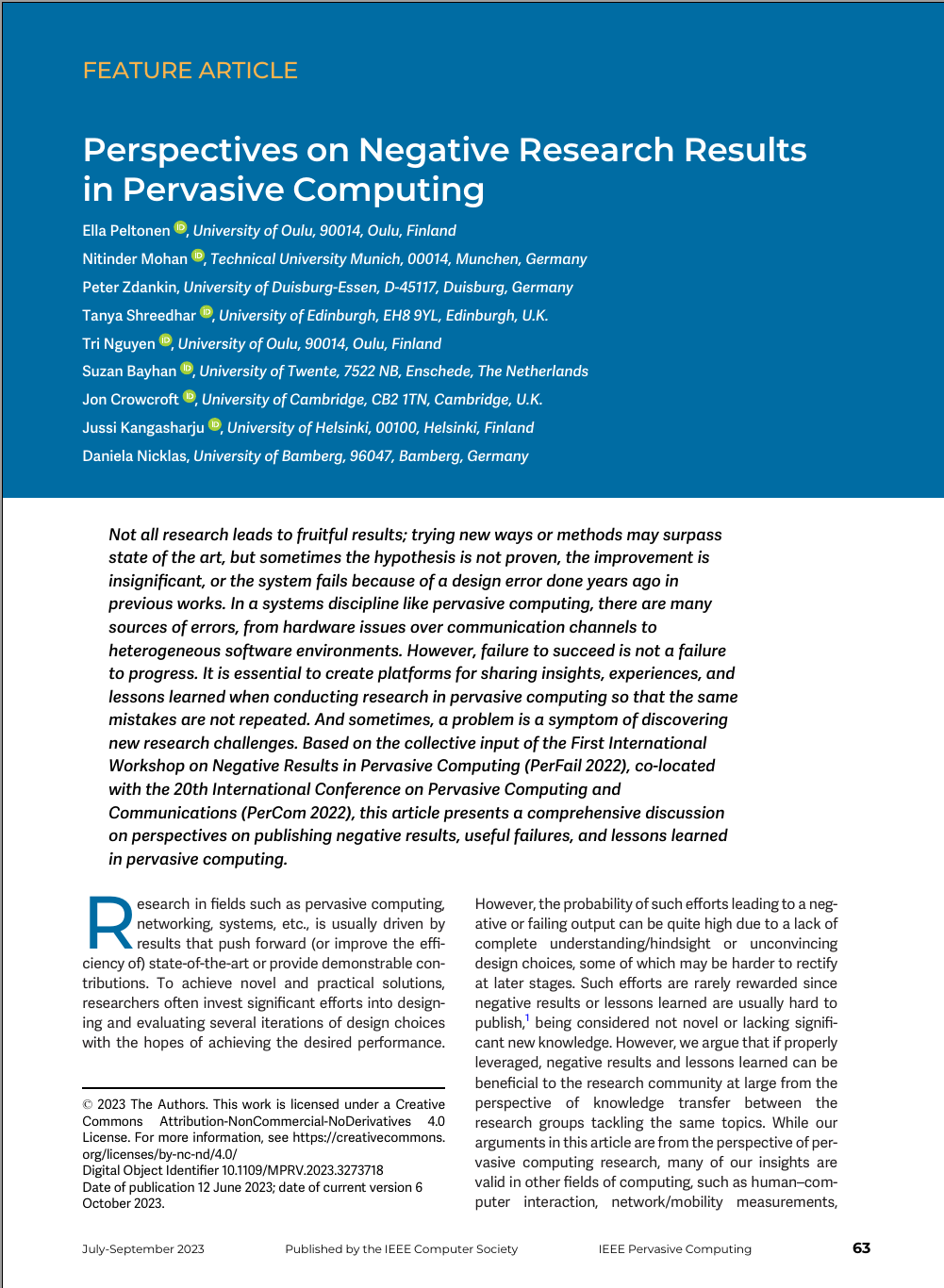
Not all research leads to fruitful results; trying new ways or methods may surpass the state of the art, but sometimes the hypothesis is not proven or the improvement is insignificant. In a systems discipline like pervasive computing, there are many sources of errors, from hardware issues over communication channels to heterogeneous software environments. However, failure to succeed is not a failure to progress. It is essential to create platforms for sharing insights, experiences, and lessons learned when conducting research in pervasive computing so that the same mistakes are not repeated. And sometimes, a problem is a symptom of discovering new research challenges. Based on the collective input of the First International Workshop on Negative Results in Pervasive Computing (PerFail 2022), co-located with the 20th International Conference on Pervasive Computing and Communications (PerCom 2022), this paper presents a comprehensive discussion on perspectives on publishing negative results and lessons learned in pervasive computing.
@article{perfail-pervasive2023,author={Peltonen, Ella and Mohan, Nitinder and Zdankin, Peter and Shreedhar, Tanya and Nguyen, Tri and Bayhan, Suzan and Crowcroft, Jon and Kangasharju, Jussi and Nicklas, Daniela},journal={IEEE Pervasive Computing},title={Perspectives on Negative Research Results in Pervasive Computing},year={2023},volume={22},number={3},pages={63-72},doi={10.1109/MPRV.2023.3273718},note={<i>Impact Factor: 3.175</i>}}
2022
Evaluating QUIC Performance Over Web, Cloud Storage, and Video Workloads
Tanya Shreedhar, Rohit Panda, Sergey Podanev, and Vaibhav Bajpai
IEEE Transactions on Network and Service Management, 2022
QUIC was launched in 2013 with a goal to provide reliable, connection-oriented and end-to-end encrypted transport and is recently standardized in May 2021 by the Internet Engineering Task Force (IETF). This work evaluates QUIC performance over the web, cloud storage, and video workloads and compares them to traditional TLS/TCP. We target Alexa Top-1M websites and measure approximately 5.7K websites that support QUIC. We observe that QUIC has approximately 140% lower mean connection times than TLS 1.2/1.3 over TCP for low-bandwidth and high-RTT networks. For cloud storage, TLS 1.2 over TCP exhibits higher throughput for larger file sizes (>20 MB), while QUIC exhibits higher throughput for smaller file sizes. For video workloads, QUIC tends to depict better content delivery with reduced stall events and up to 50% lower stall durations due to its lower latency overheads.
@article{9646248,author={Shreedhar, Tanya and Panda, Rohit and Podanev, Sergey and Bajpai, Vaibhav},journal={IEEE Transactions on Network and Service Management},title={Evaluating QUIC Performance Over Web, Cloud Storage, and Video Workloads},year={2022},volume={19},number={2},pages={1366-1381},doi={10.1109/TNSM.2021.3134562},note={<i>Impact Factor: 5.3</i>},}
Coexistence of Age Sensitive Traffic and High Throughput Flows: Does Prioritization Help?
Tanya Shreedhar, Sanjit K. Kaul, and Roy D. Yates
In IEEE INFOCOM Workshop on Age of Information (AoI), 2022
We study the coexistence of high throughput traffic flows with status update flows that require timely delivery of updates. A mix of these flows share an end-to-end path that includes a WiFi access network followed by paths over the Internet to a server in the cloud. Using real-world experiments, we show that commonly used methods of prioritization (DSCP at the IP layer and EDCA at the 802.11 MAC layer) in networks are highly effective in isolating status update flows from the impact of high throughput flows in the absence of WiFi access contention, say when all flows originate from the same WiFi client. Prioritization, however, isn’t as effective in the presence of contention that results from the throughput and status update flows sharing WiFi. This results in prioritized status update flows suffering from a time-average age of information at the destination server that is about the same as when all flows have the same priority.
@inproceedings{9798247,author={Shreedhar, Tanya and Kaul, Sanjit K. and Yates, Roy D.},booktitle={IEEE INFOCOM Workshop on Age of Information (AoI)},title={Coexistence of Age Sensitive Traffic and High Throughput Flows: Does Prioritization Help?},year={2022},pages={1-6},doi={10.1109/INFOCOMWKSHPS54753.2022.9798247},}
Impact of Evolving Protocols and COVID-19 on Internet Traffic Shares
Luca Schumann, Trinh Viet Doan, Tanya Shreedhar, Ricky K. P. Mok, and Vaibhav Bajpai
The rapid deployment of new Internet protocols over the last few years and the COVID-19 pandemic more recently has resulted in a change in the Internet traffic composition. We examine traffic at two monitoring points, one in Japan and one in the USA, analyzing 100GB and 4TB of data respectively. We document pandemic-related shifts toward remote work tools, observe IPv6 adoption increasing from 1.1% to 6.1% on one link, and find that encrypted web traffic now comprises approximately two-thirds of HTTP(S) traffic, representing a significant increase compared to earlier studies.
@article{DBLP:journals/corr/abs-2201-00142,author={Schumann, Luca and Doan, Trinh Viet and Shreedhar, Tanya and Mok, Ricky K. P. and Bajpai, Vaibhav},title={Impact of Evolving Protocols and {COVID-19} on Internet Traffic Shares},journal={Computing Research Repository (CoRR), arXiv},volume={abs/2201.00142},year={2022},}
A Longitudinal View at the Adoption of Multipath TCP
Tanya Shreedhar, Danesh Zeynali, Oliver Gasser, Nitinder Mohan, and Jörg Ott
Multipath TCP (MPTCP) extends traditional TCP to enable simultaneous use of multiple connection endpoints at the source and destination. This research analyzes both MPTCPv0 and MPTCPv1 deployment across the Internet through comprehensive scanning of IPv4 and IPv6 address spaces on ports 80 and 443. Key findings include a doubling of MPTCPv0-capable IPs on IPv4 to over 13,000 within one year, while MPTCPv1 adoption remains minimal at approximately 100 hosts, predominantly Apple devices. The study identifies middleboxes as a significant factor affecting MPTCP performance and examines real-world traffic patterns using CAIDA and MAWI datasets, revealing that despite a twentyfold increase in MPTCP usage over recent years, its overall traffic share remains relatively low.
@article{shreedhar2022longitudinal,title={A Longitudinal View at the Adoption of Multipath TCP},author={Shreedhar, Tanya and Zeynali, Danesh and Gasser, Oliver and Mohan, Nitinder and Ott, J{\"o}rg},journal={Computing Research Repository (CoRR), arXiv},volume={abs/2205.12138},year={2022},}
2021
Distributed Ledgers for Distributed Edge: Are We There Yet?
Leo Eichhorn, Tanya Shreedhar, Aleksandr Zavodovski, and Nitinder Mohan
In ACM CoNext Interdisciplinary Workshop on (de) Centralization in the Internet, 2021
Distributed ledgers offer promising solutions for edge computing scenarios, enabling decentralized coordination and trust. This work evaluates the feasibility and performance of distributed ledger technologies in distributed edge environments, examining whether current implementations meet the requirements of edge computing use cases.
@inproceedings{10.1145/3488663.3493687,author={Eichhorn, Leo and Shreedhar, Tanya and Zavodovski, Aleksandr and Mohan, Nitinder},title={Distributed Ledgers for Distributed Edge: Are We There Yet?},year={2021},doi={10.1145/3488663.3493687},booktitle={ACM CoNext Interdisciplinary Workshop on (de) Centralization in the Internet},pages={26–33},numpages={8},}
From Single Lane to Highways: Analyzing the Adoption of Multipath TCP in the Internet
Florian Aschenbrenner, Tanya Shreedhar, Oliver Gasser, Nitinder Mohan, and Jörg Ott
Multipath TCP (MPTCP) extends traditional TCP to enable simultaneous use of multiple connection endpoints at the source and destination. MPTCP has been under active development since its standardization in 2013, and more recently in February 2020, MPTCP was upstreamed to the Linux kernel. The researchers conducted comprehensive scans of the IPv4 address space and IPv6 hitlist to identify MPTCP-capable systems on ports 80 and 443. Their findings revealed steady growth in MPTCP adoption, reaching over 9,000 IPv4 addresses and dozens on IPv6. However, they also discovered that middleboxes significantly impact application performance by mirroring TCP options. Analysis of traffic data from CAIDA and MAWI showed MPTCP usage has increased by a factor of 20 over the past few years, its traffic share is still quite low.
@inproceedings{9472785,author={Aschenbrenner, Florian and Shreedhar, Tanya and Gasser, Oliver and Mohan, Nitinder and Ott, Jörg},booktitle={IFIP Networking Conference},title={From Single Lane to Highways: Analyzing the Adoption of Multipath TCP in the Internet},year={2021},volume={},number={},pages={1-9},doi={10.23919/IFIPNetworking52078.2021.9472785},note={<i>Acceptance Rate: 24.7%</i>}}
Beyond QUICv1: A first look at recent transport layer IETF standardization efforts
The transport layer is ossified. With most of the research and deployment efforts in the past decade focussing on the Transmission Control Protocol (TCP) and its extensions, the QUIC standardization by the Internet Engineering Task Force (IETF) is to be finalized in early 2021. In addition to addressing the most urgent issues of TCP, QUIC ensures its future extendibility and is destined to drastically change the transport protocol landscape. In this work, we present a first look at emerging protocols and their IETF standardization efforts beyond QUIC v1. While multiple proposed extensions improve on QUIC itself, Multiplexed Application Substrate over QUIC Encryption (MASQUE) as well as WebTransport present different approaches to address long-standing problems, and their interplay extends on QUIC’s take to address transport layer ossification challenges.
@article{kosek2021beyond,title={Beyond QUICv1: A first look at recent transport layer IETF standardization efforts},author={Kosek, Mike and Shreedhar, Tanya and Bajpai, Vaibhav},journal={IEEE Communications Magazine},volume={59},number={4},pages={24--29},year={2021},publisher={IEEE},note={<i>Impact Factor: 9.619</i>},}
An Empirical Study of Ageing in the Cloud
Tanya Shreedhar, Sanjit K. Kaul, and Roy D. Yates
In IEEE INFOCOM 2021 - IEEE Conference on Computer Communications Workshops (INFOCOM WKSHPS), 2021
We quantify, over inter-continental paths, the ageing of TCP packets, throughput and delay for different TCP congestion control algorithms containing a mix of loss-based, delay-based and hybrid congestion control algorithms. The research compares these TCP variants to ACP+, demonstrating its superior performance in delivering timely updates across high-capacity, long-distance networks. ACP+ adapts update rates to minimize age while achieving comparable average age to the best-performing TCP algorithm, but at significantly lower end-to-end throughputs. The study also documents substantial improvements ACP+ provides for age control over shared multiaccess channels.
@inproceedings{9484567,author={Shreedhar, Tanya and Kaul, Sanjit K. and Yates, Roy D.},booktitle={IEEE INFOCOM 2021 - IEEE Conference on Computer Communications Workshops (INFOCOM WKSHPS)},title={An Empirical Study of Ageing in the Cloud},year={2021},volume={},number={},pages={1-6},doi={10.1109/INFOCOMWKSHPS51825.2021.9484567},}
2019
An Age Control Transport Protocol for Delivering Fresh Updates in the Internet-of-Things
Tanya Shreedhar, Sanjit K. Kaul, and Roy D. Yates
In 20th International Symposium on "A World of Wireless, Mobile and Multimedia Networks" (WoWMoM), 2019
@inproceedings{8793011,author={Shreedhar, Tanya and Kaul, Sanjit K. and Yates, Roy D.},booktitle={20th International Symposium on "A World of Wireless, Mobile and Multimedia Networks" <strong>(WoWMoM)</strong>},title={An Age Control Transport Protocol for Delivering Fresh Updates in the Internet-of-Things},year={2019},volume={},number={},pages={1-7},doi={10.1109/WoWMoM.2019.8793011},note={<i>Acceptance Rate: 24.7%</i>}}
Is two greater than one?: Analyzing Multipath TCP over Dual-LTE in the Wild
Nitinder Mohan, Tanya Shreedhar, Aleksandr Zavodovski, Jussi Kangasharju, and Sanjit K. Kaul
@article{DBLP:journals/corr/abs-1909-02601,author={Mohan, Nitinder and Shreedhar, Tanya and Zavodovski, Aleksandr and Kangasharju, Jussi and Kaul, Sanjit K.},title={Is two greater than one?: Analyzing Multipath {TCP} over Dual-LTE
in the Wild},volume={abs/1909.02601},year={2019},journal={Computing Research Repository (CoRR), arXiv},}
2018
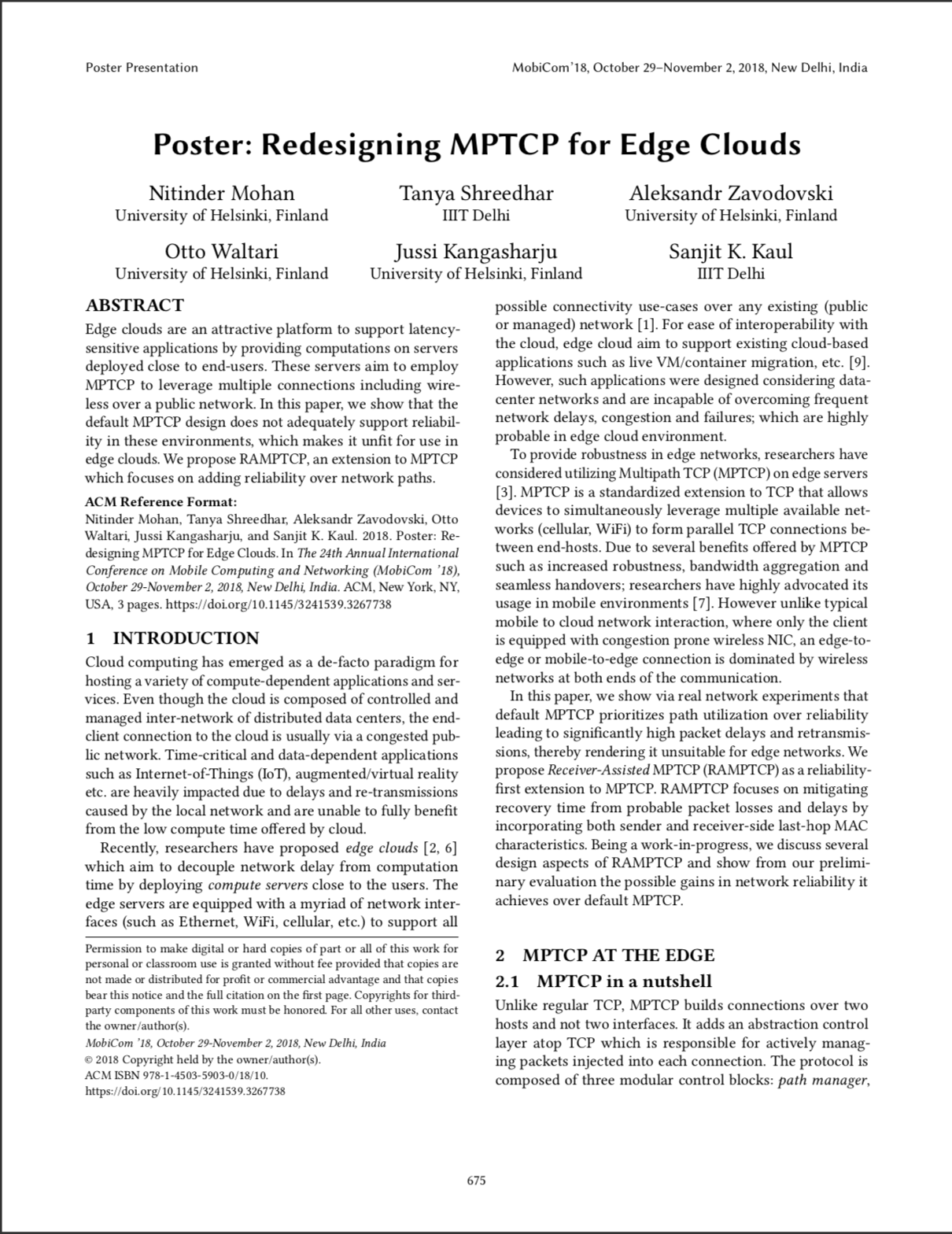
Redesigning MPTCP for Edge Clouds
Nitinder Mohan, Tanya Shreedhar, Aleksandr Zavodavoski, Otto Waltari, Jussi Kangasharju, and Sanjit K. Kaul
In 24th Annual International Conference on Mobile Computing and Networking (MobiCom), 2018
@inproceedings{10.1145/3241539.3267738,author={Mohan, Nitinder and Shreedhar, Tanya and Zavodavoski, Aleksandr and Waltari, Otto and Kangasharju, Jussi and Kaul, Sanjit K.},title={Redesigning MPTCP for Edge Clouds},year={2018},isbn={9781450359030},publisher={Association for Computing Machinery},address={New York, NY, USA},url={https://doi.org/10.1145/3241539.3267738},doi={10.1145/3241539.3267738},booktitle={24th Annual International Conference on Mobile Computing and Networking <strong>(MobiCom)</strong>},pages={675–677},numpages={3},}
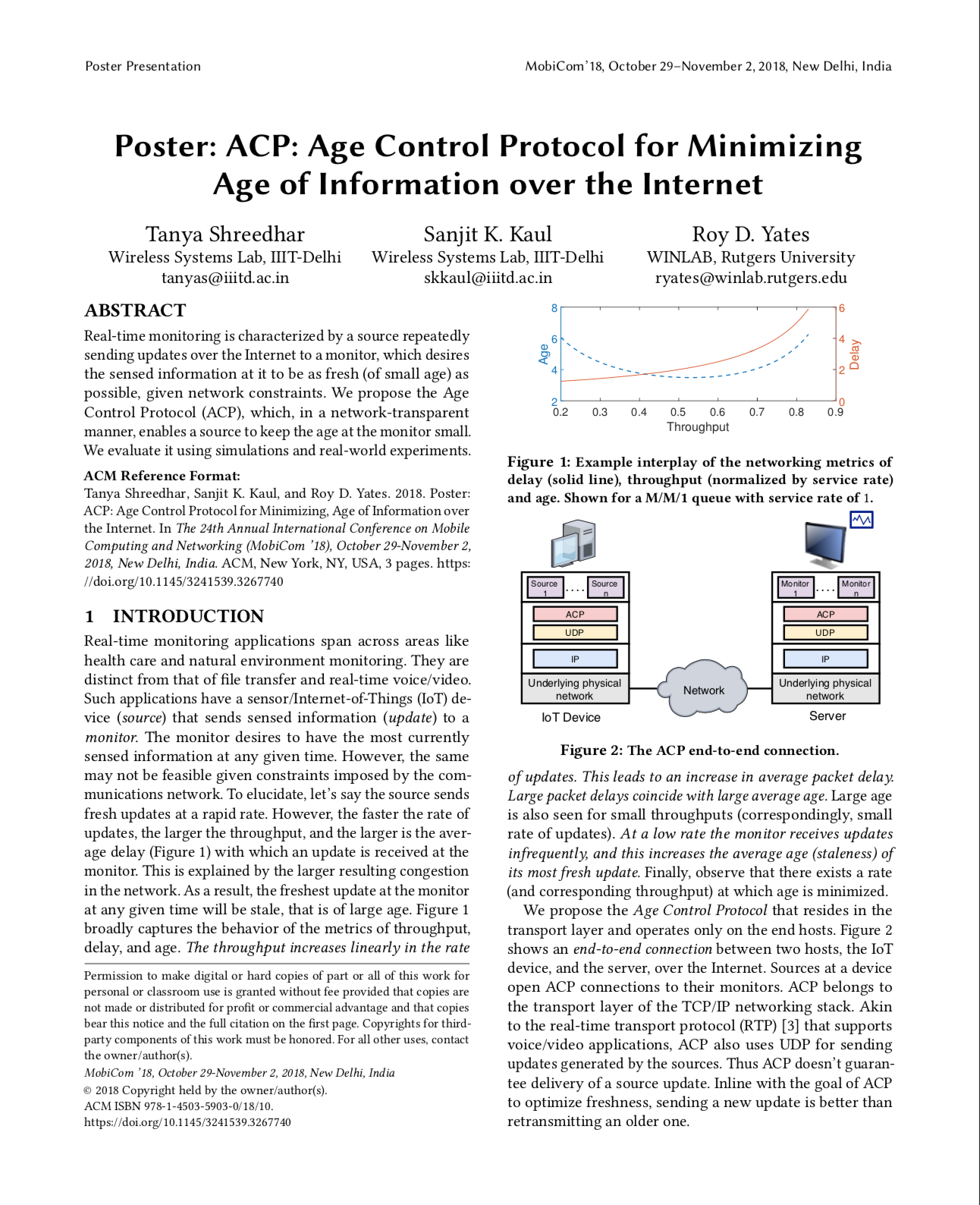
ACP: Age Control Protocol for Minimizing Age of Information over the Internet
Tanya Shreedhar, Sanjit K. Kaul, and Roy D. Yates
In 24th Annual International Conference on Mobile Computing and Networking (MobiCom), 2018
@inproceedings{10.1145/3241539.3267740,author={Shreedhar, Tanya and Kaul, Sanjit K. and Yates, Roy D.},title={ACP: Age Control Protocol for Minimizing Age of Information over the Internet},year={2018},isbn={9781450359030},publisher={Association for Computing Machinery},address={New York, NY, USA},url={https://doi.org/10.1145/3241539.3267740},doi={10.1145/3241539.3267740},booktitle={24th Annual International Conference on Mobile Computing and Networking <strong>(MobiCom)</strong>},pages={699–701},numpages={3},}
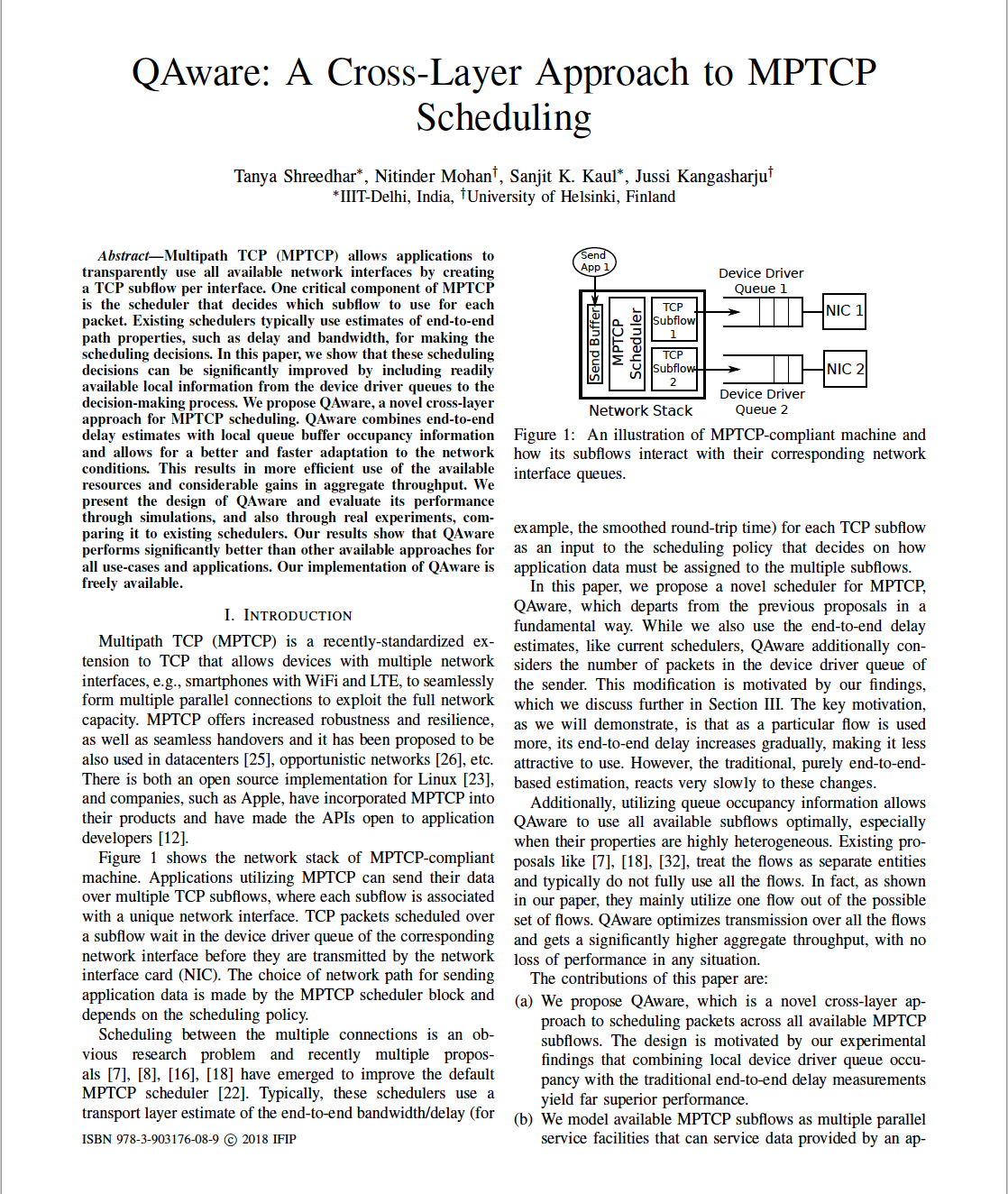
QAware: A Cross-Layer Approach to MPTCP Scheduling
Tanya Shreedhar, Nitinder Mohan, Sanjit K. Kaul, and Jussi Kangasharju
In 2018 IFIP Networking Conference (IFIP Networking) and Workshops, 2018
@inproceedings{8696843,author={Shreedhar, Tanya and Mohan, Nitinder and Kaul, Sanjit K. and Kangasharju, Jussi},booktitle={2018 IFIP Networking Conference (IFIP Networking) and Workshops},title={QAware: A Cross-Layer Approach to MPTCP Scheduling},year={2018},volume={},number={},pages={1-9},doi={10.23919/IFIPNetworking.2018.8696843},note={<i>Acceptance Rate: 24.4%</i>}}
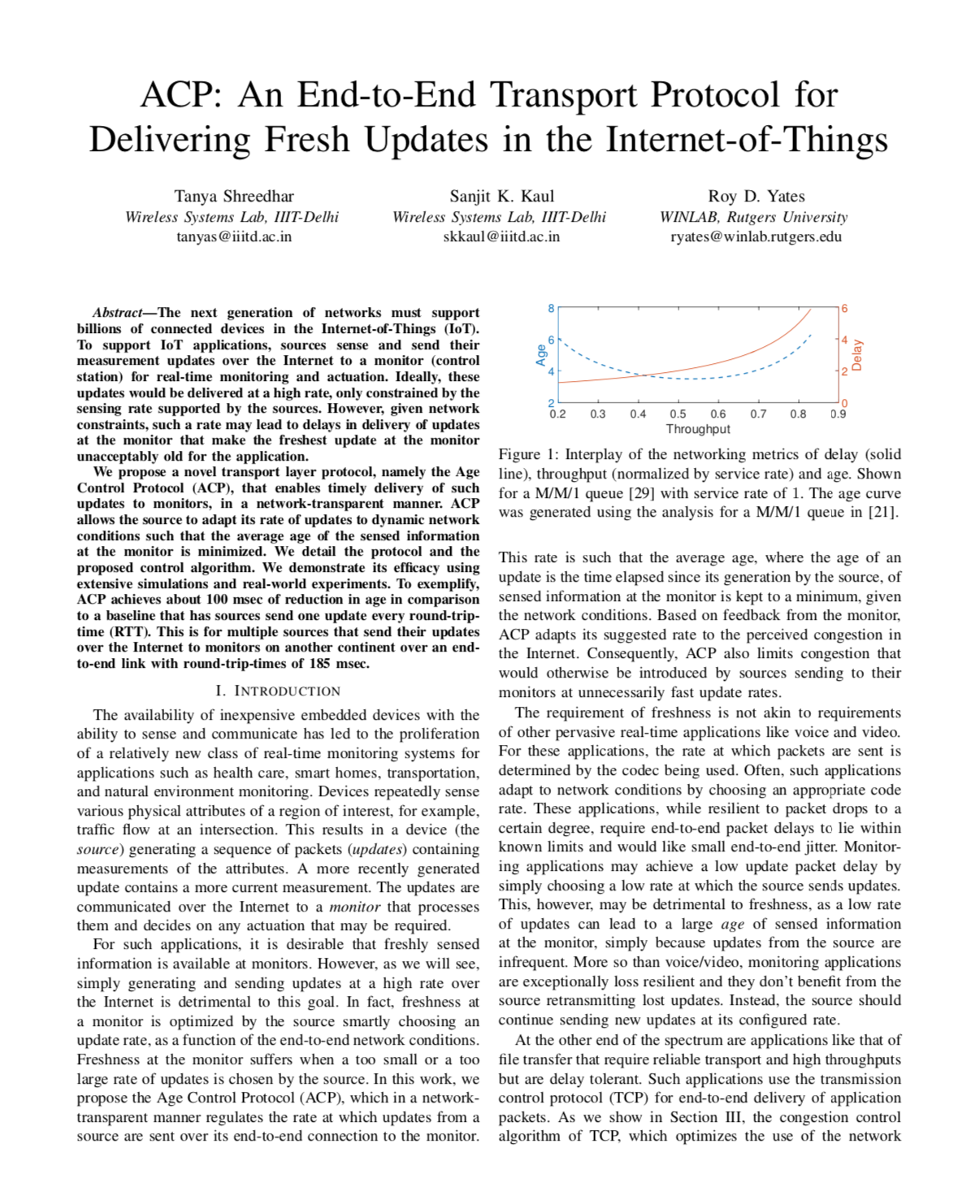
ACP: An End-to-End Transport Protocol for Delivering Fresh Updates in the Internet-of-Things
@article{DBLP:journals/corr/abs-1811-03353,author={Shreedhar, Tanya and Kaul, Sanjit K. and Yates, Roy D.},title={{ACP:} An End-to-End Transport Protocol for Delivering Fresh Updates
in the Internet-of-Things},journal={Computing Research Repository (CoRR), arXiv},volume={abs/1811.03353},year={2018},}
2017
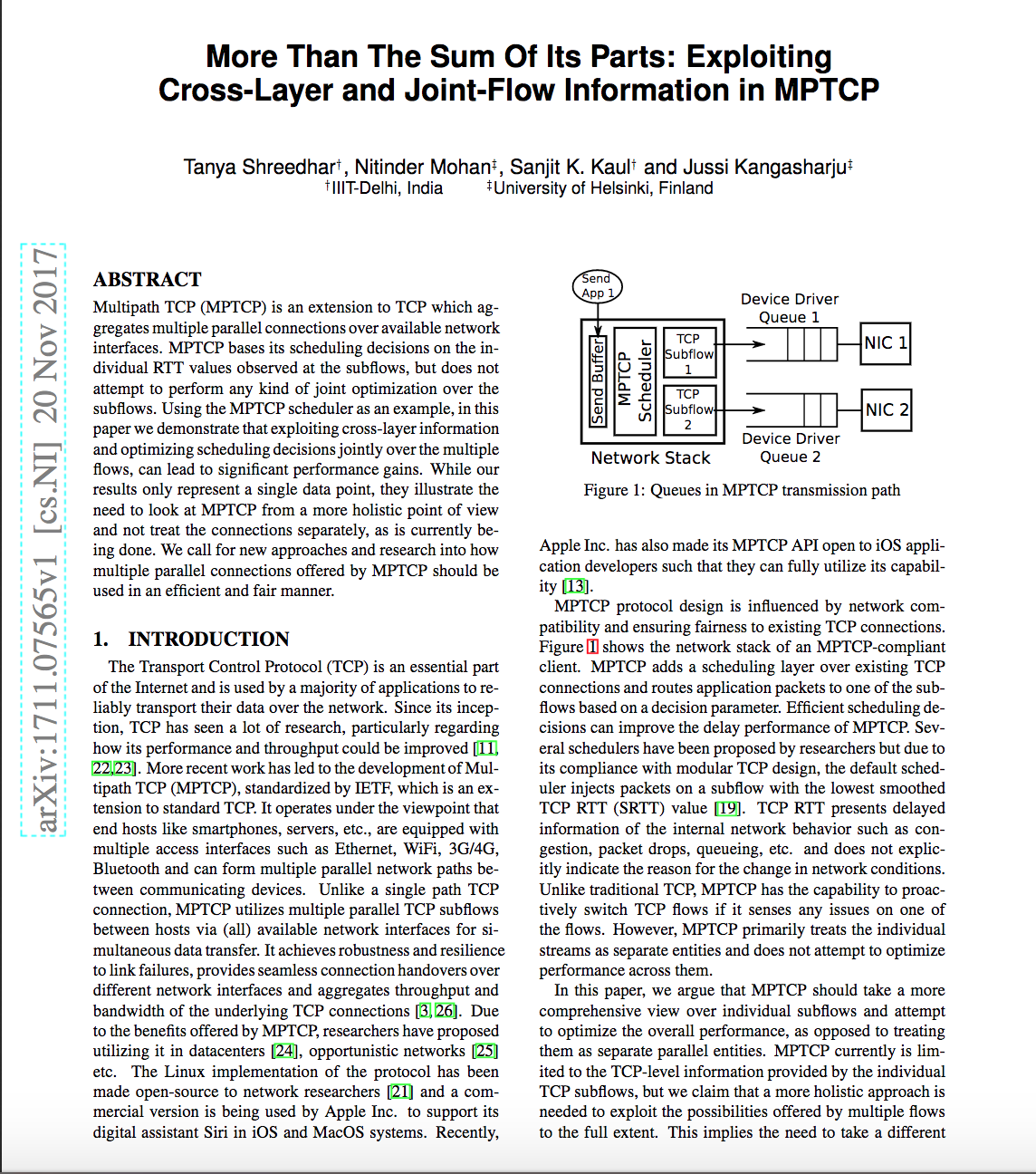
More Than The Sum Of Its Parts: Exploiting Cross-Layer and Joint-Flow Information in MPTCP
Tanya Shreedhar, Nitinder Mohan, Sanjit K. Kaul, and Jussi Kangasharju
@article{DBLP:journals/corr/abs-1711-07565,author={Shreedhar, Tanya and Mohan, Nitinder and Kaul, Sanjit K. and Kangasharju, Jussi},title={More Than The Sum Of Its Parts: Exploiting Cross-Layer and Joint-Flow
Information in {MPTCP}},journal={Computing Research Repository (CoRR), arXiv},volume={abs/1711.07565},year={2017},}
2016
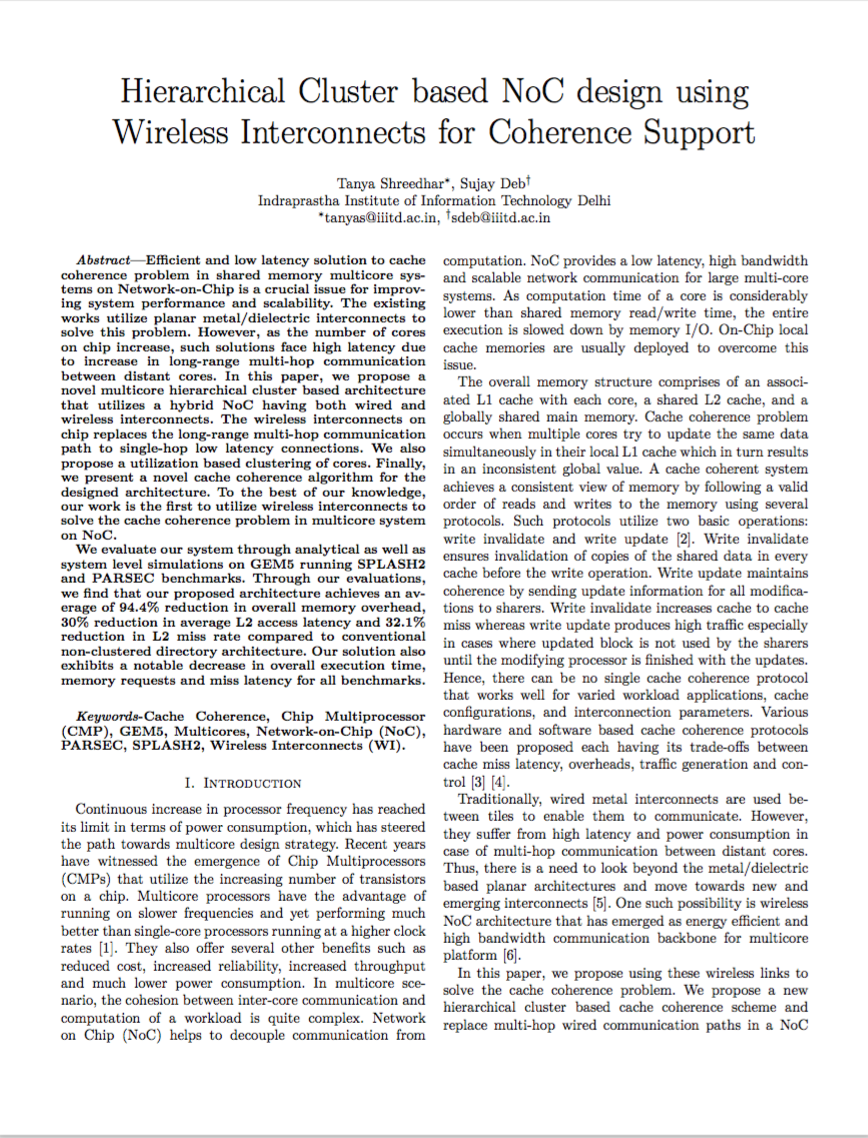
Hierarchical Cluster Based NoC Design Using Wireless Interconnects for Coherence Support
Tanya Shreedhar, and Sujay Deb
In 29th International Conference on VLSI Design (VLSID), 2016
@inproceedings{7434928,author={Shreedhar, Tanya and Deb, Sujay},booktitle={29th International Conference on VLSI Design <strong>(VLSID)</strong>},title={Hierarchical Cluster Based NoC Design Using Wireless Interconnects for Coherence Support},year={2016},volume={},number={},pages={63-68},doi={10.1109/VLSID.2016.54},}